Netflix Churners Research
Type of Project
UX Research, Strategy
Team
Me, Ajia Grant, Kelly Hu, Vivian Tsang, Zoya Razzak, Victoria Bellotti
Role
Research consultant, final deliverables sprint leader
Duration
Sep - Dec 2020
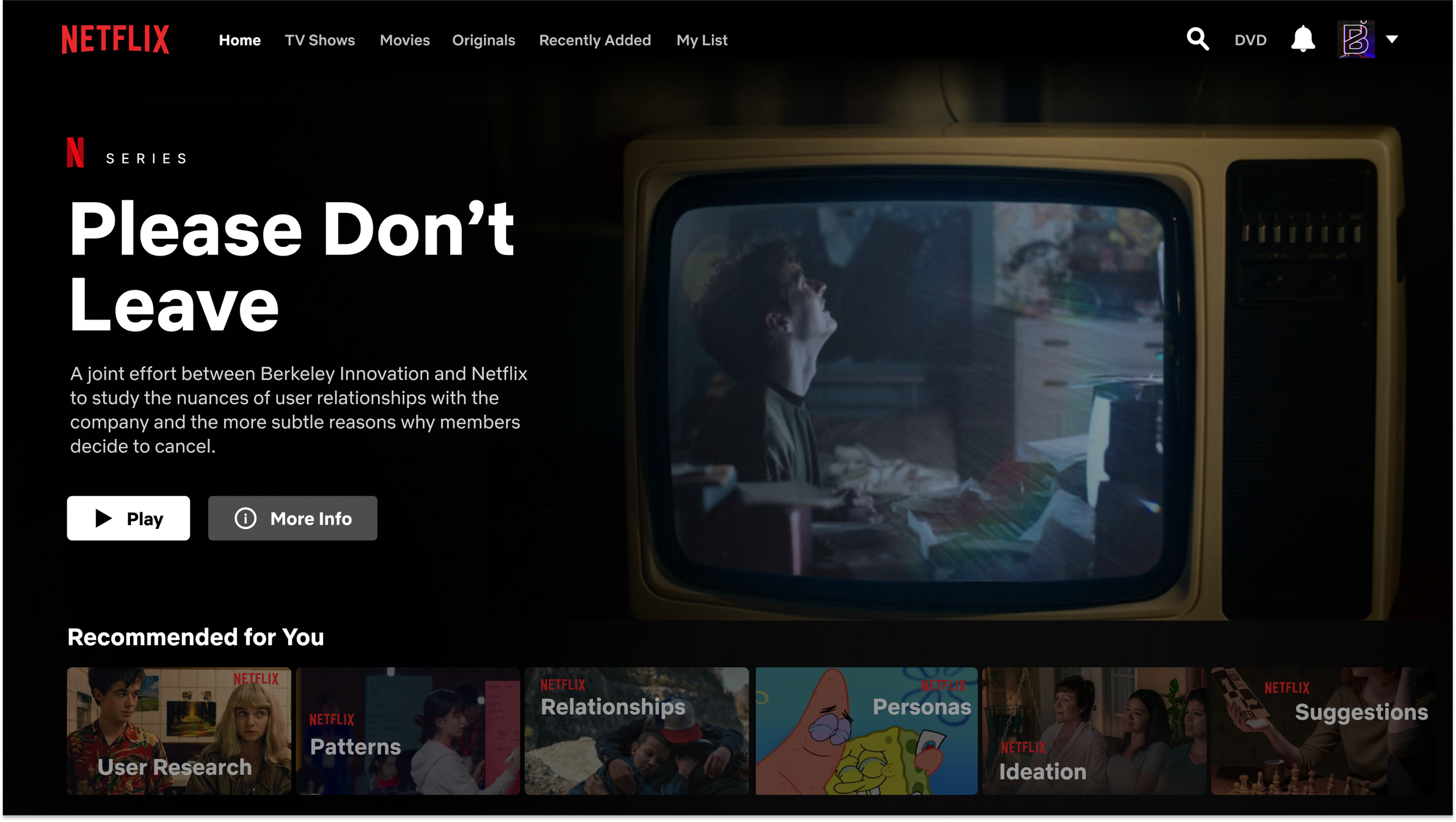
Understanding the more nuanced reasons people leave Netflix and how we can make these members more inclined to stay
Problem
Approximately 9 million people cancel their Netflix membership every month.
Based on data collected by Netflix’s cancellation reasons survey, we knew the common reasons members cancel, which are price, time, content, and performance-related issues. However, there was a significant percentage of members who reported leaving for other reasons, which sparked Netflix’s interest in understanding some of the more subtle reasons people cancel or churn and how might we make them more inclined to stay.
Initial Assumptions
If we can foster a greater sense of brand loyalty, then ex-members will be more likely to reconsider canceling despite having some issue(s) with Netflix.
An assumption we had in the beginning that we wanted to explore was that if we can foster a greater sense of brand loyalty, then ex-members and churners will reconsider leaving despite having some issue(s) with Netflix.
Through extensive research into people’s relationships with Netflix, we discovered some less common, but serious issues and some more nuanced,
but probably quite common reasons, loyalty can break or erode.
Secondary Research
People humanize brands as they do with their pets, cars, etc.
Based on the previous research Netflix has done in this problem space, literature reviews, social media scans, and competitive analysis of other subscription services, we discovered some key insights about Netflix, para-social bonds, and human motivations.
Key Insights
![]()
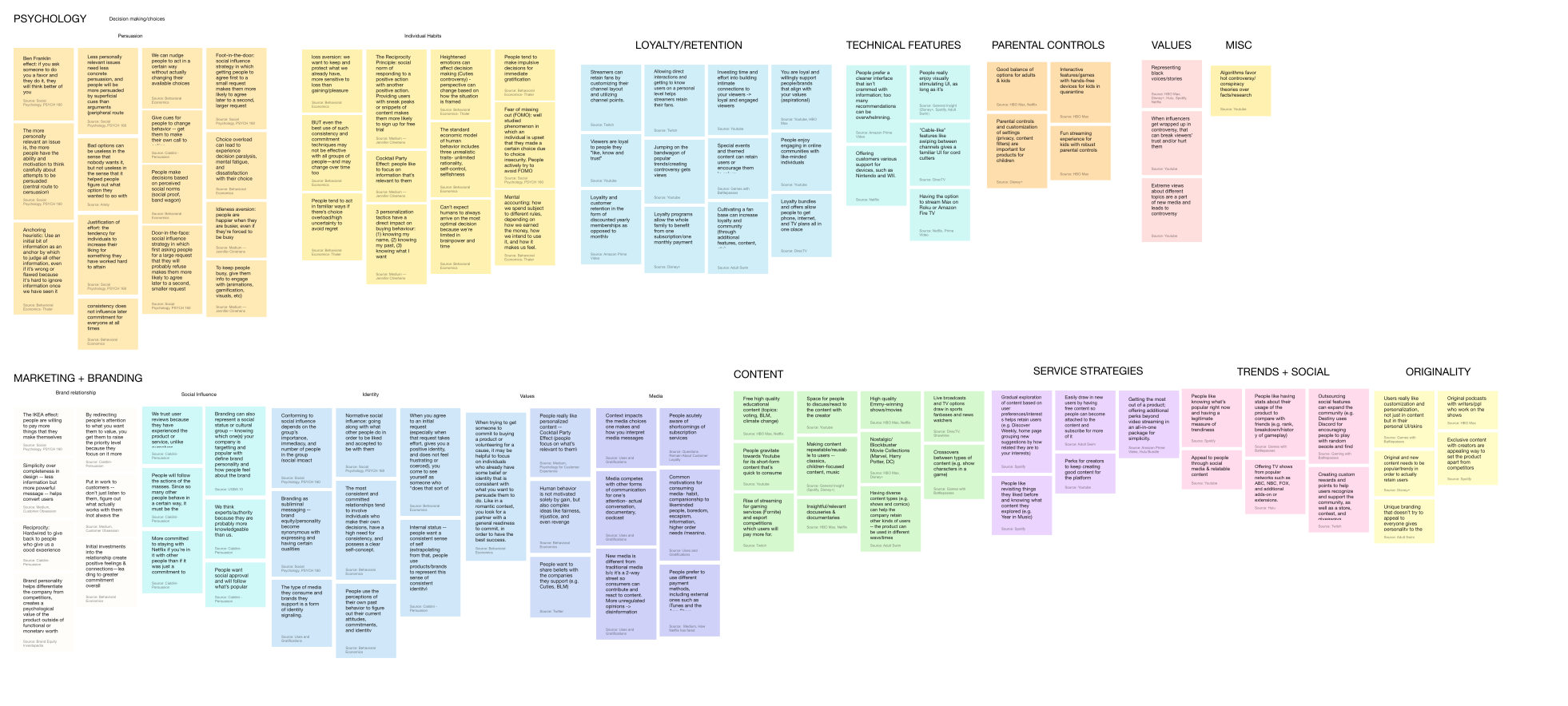
Competitive Analysis
- Content should be nostalgic, trendy, exclusive and/or socially relevant
- People appreciate loyalty perks
- Social features and personalization can be attractive
- People like having options for the entire family
Human Behavior
- Many choices are overwhelming, and we will fall back on what’s familiar.
- We are more persuaded by what’s personally relevant.
- Pro-social behavior feels rewarding to us, but only if it’s easily accessible.
- We are innately risk averse and are more sensitive to what we lose.
Brand Relationships
- Brands are a form of status, expression, and belonging.
- Trends and social media are influential since we trust them as experts.
- Norm of reciprocity: we will give back to those who give us a good experience.
Initial Research
Interviews + Concept Map
Interviews + Concept Map
We learned that loyalty to Netflix can be broken or eroded because of a lack of trust, communication, and excessive binging.
We recruited 13 participants from the U.S, Canada, and India who have either left, rejoined, or were considering leaving Netflix to interview for 1 hour, each asking questions that can be roughly grouped into the following categories.
![]()
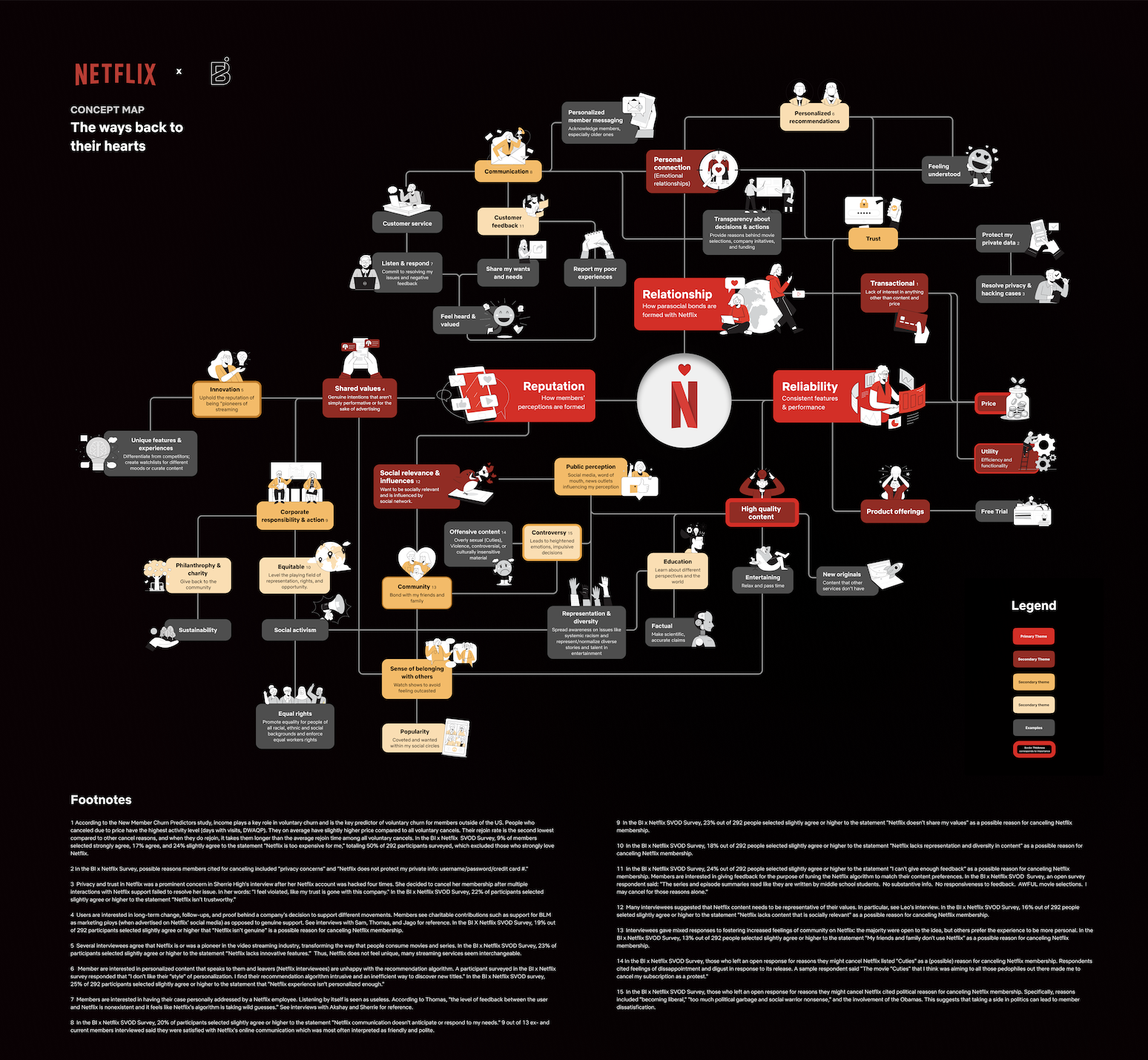
We used affinity mapping to synthesize our qualitative data and visualize the emerging themes, which formed the basis of our concept map, depicting the connections between sub-themes that branch off from the 3 main things that influenced people’s decision to leave: reputation, reliability, and relationship.

Survey
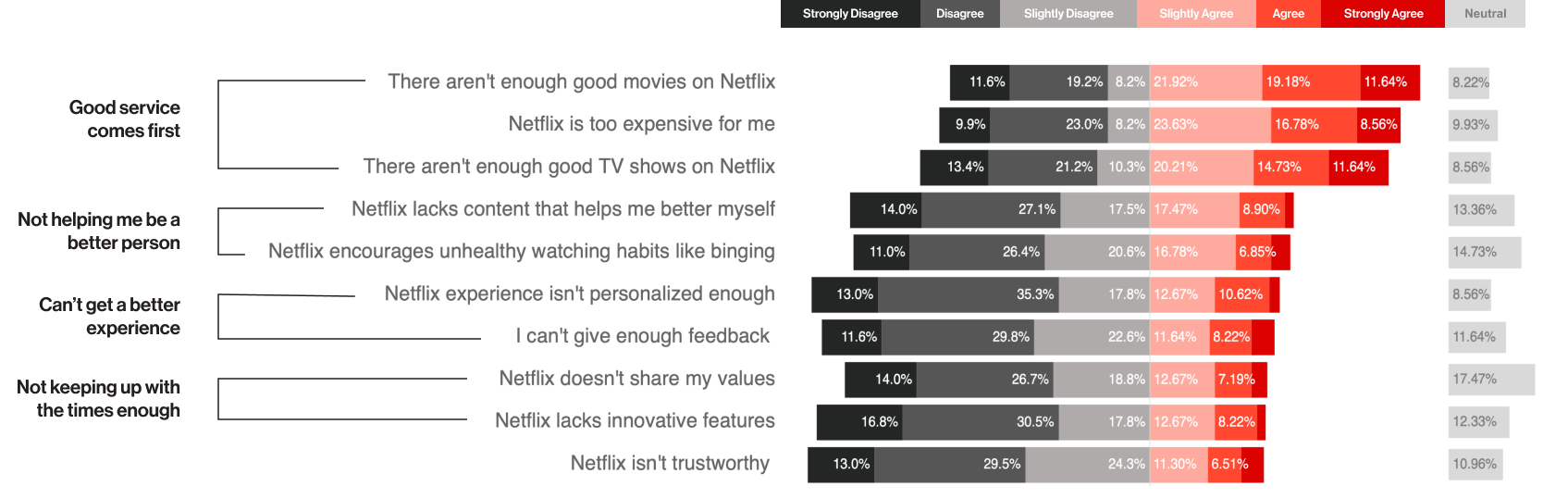
Based on our interview insights, we conducted a brief survey with 344 participants to gage the relative importance of the cancellation reasons that came up during the interview stage.
![]()
Factor Analysis
After, we used factor analysis to discover deeper insights into patterns in our data and quantify the significance of our qualitative insights. We extracted 5 factors from the survey data using PCA to see how the potential cancellation reasons from our survey relate to each other and the outcomes of interest: satisfaction with Netflix and likelihood of leaving Netflix.
![]()

Concept Testing
We also explored how people felt about potential ideas and themes Netflix could foster to change their mind about cancelling in the interviews. The majority reacted…
Positively to
Having a community to discuss and recommend content
Giving feedback to Netflix
Netflix promoting values through representation and social corporate action
Mixed reactions to
Nostalgia
Learning about cultures, nature, hobbies
Social networks to discuss what’s exciting or meaningful
Showing emotion after members leave
Negatively to
Reaching out
Giving more guidance on how to use Netflix better
Personas
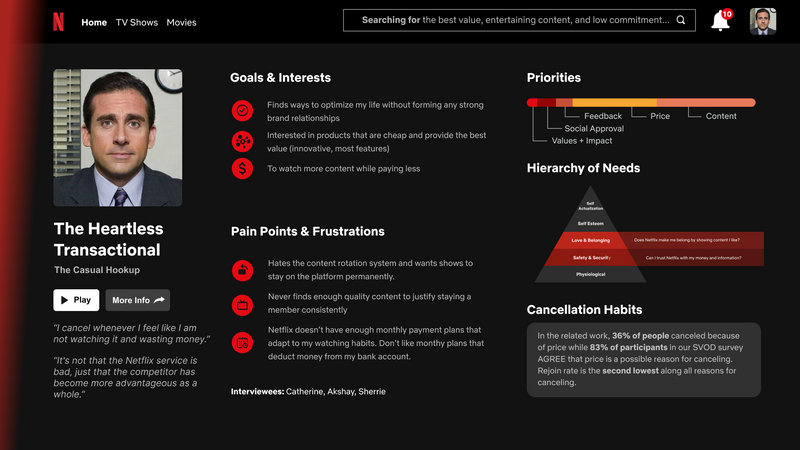
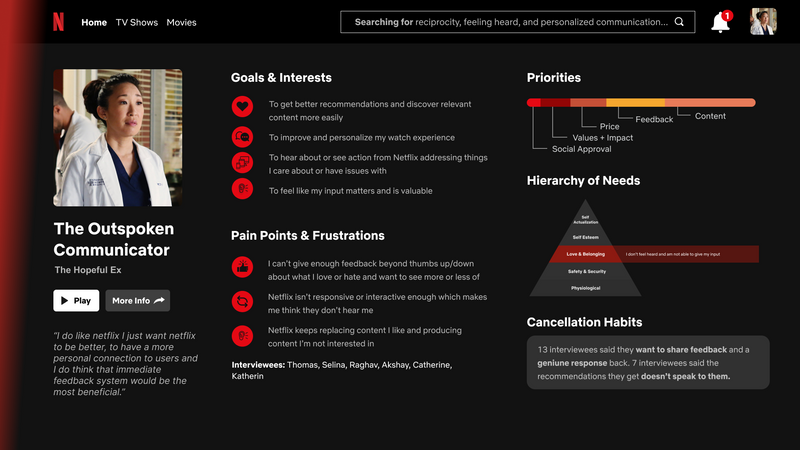
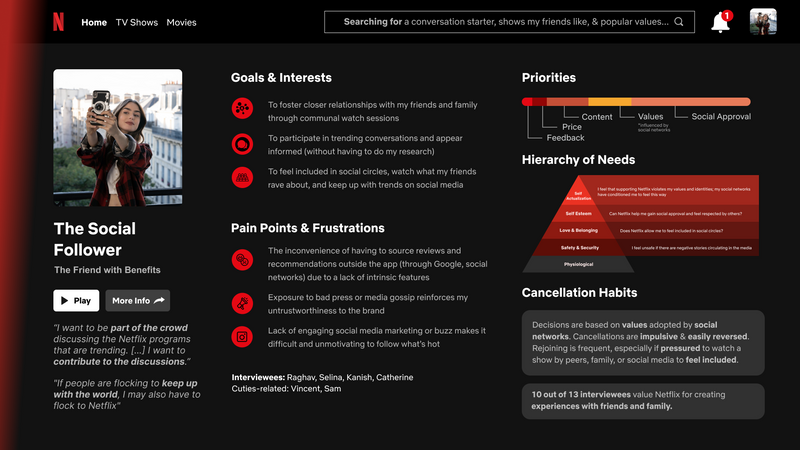
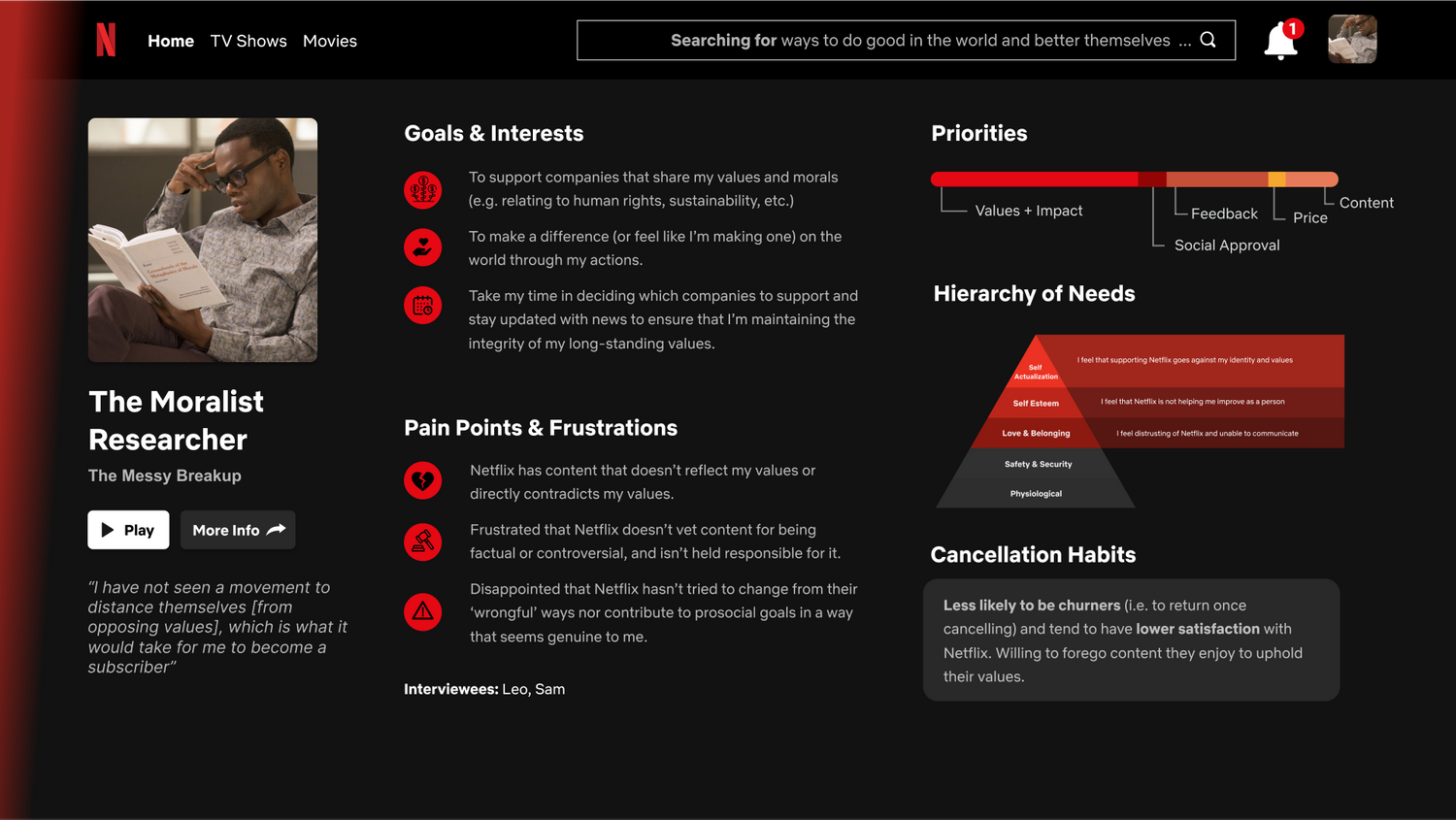
After conducting our interviews and survey, we created 4 personas to represent the members who have left Netflix, their cancellation habits, and unmet needs.
![]()
![]()
![]()
![]()
Ideation
So, how might Netflix show members they like and value them?
![]()
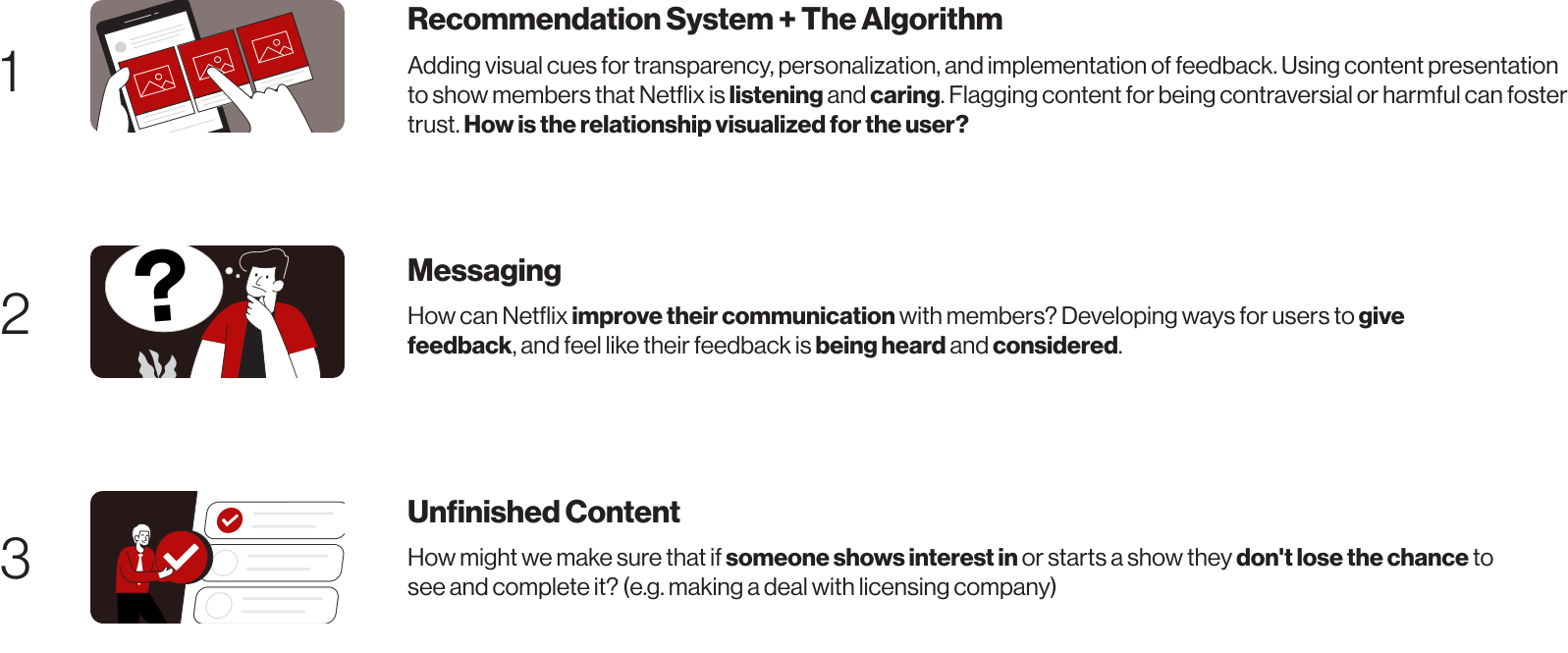
Final Outcome
We spent some time brainstorming how we wanted to structure our final presentation (i.e what would make the most compelling story). Ajia, one designer on the team, came up to present our insights based on Maslow’s Hierarchy of Needs because it fit pretty seamlessly.
The Para-social hierarchy of needs helps people visualize and better understand the relationships that members form with Netflix. Each level of the pyramid is organized in terms of strengths and weakness, which highlights how members and ex-members perceive Netflix.
︎︎︎View Behance Case Study
Reflections
![]()
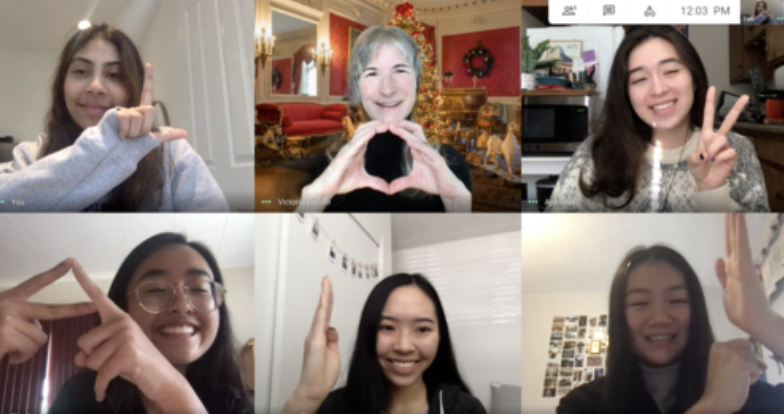
We got great reactions when we presented at the Berkeley Innovation showcase and internally to our Netflix stakeholders. Many of our findings reaffirmed research studies Netflix has conducted, which was good! The Please Don’t Leave slide presentation is still available for people at Netflix to look at and Victoria recently told us she’s still hearing a lot of great things about our presentation.
Working on this project was an invaluable experience because I learned how to conduct user research and leverage storytelling to communicate those needs and pain points to stakeholders to inform new product decisions. I’m grateful to my team for constantly challenging and supporting me.
︎︎︎ Back Next ︎︎︎
